An excruciatingly detailed review of An Evening with Haken
An Evening with Haken is one of the best concerts I have been to. Here I will break down all the details of the show.
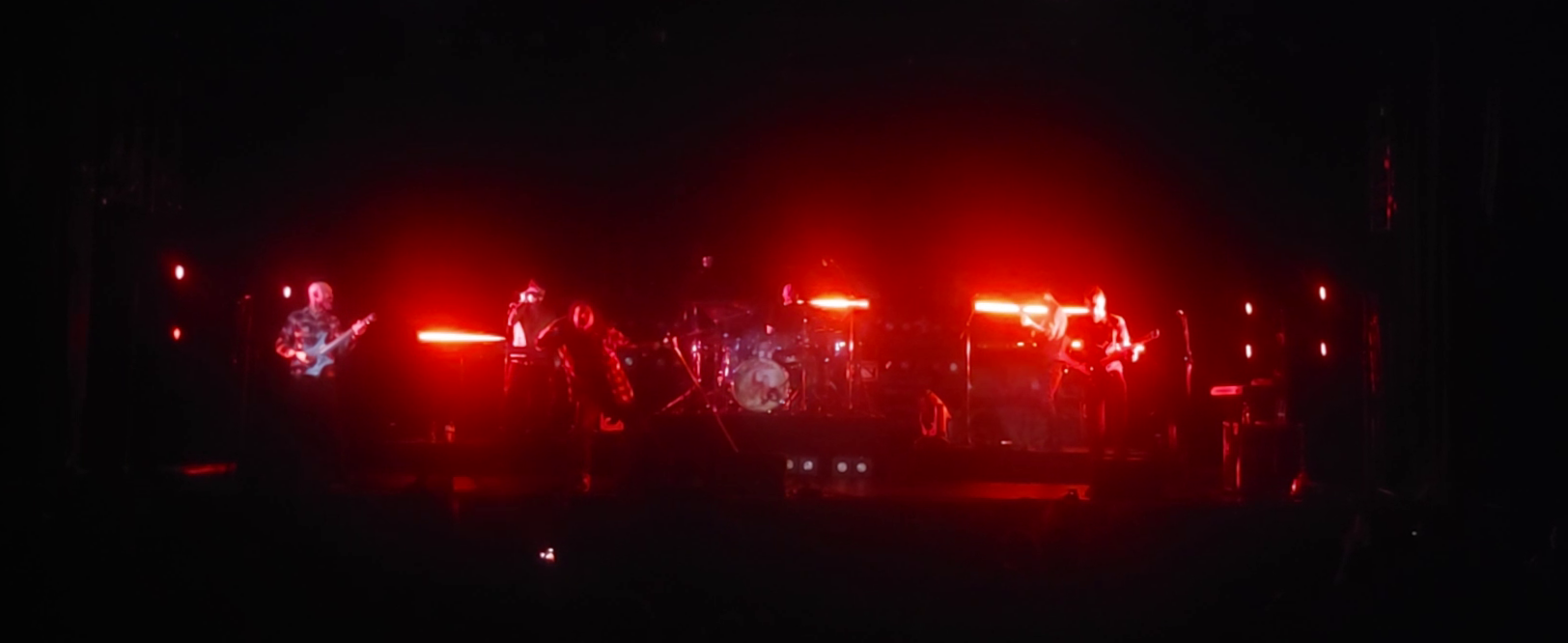
Background
When I saw Haken last summer, I came away with the feeling that they were doing something much more than making music. That show, at Le Poisson Rouge, ended with a stunning double-header of "Celestial Elixir" and "Messiah Complex." If you've never heard of Haken, those titles have probably clued you into this being a progressive band. Haken are one of my all-time favorite bands. Their music has had an enormous influence on my music. Their songs are woven deeply into my life. The show at LPR was the third time I had seen them. Previously I had seen them open for Devin Townsend and Symphony X. I will briefly comment on these third shows before getting to what we're here for; An Evening with Haken.
The first time I saw Haken, they were opening for Devin Townsend. This was the last show I went to before the pandemic. It was at Warsaw, a beloved venue in Williamsburg. Unfortunately this venue sounds distinctly like a middle school gymnasium. Overall the show wasn't great. The first time I see any band that I have followed for a long time in the flesh, I am somewhat amazed that they are actually real people. This was no different. They opened with "Puzzle Box," which is one of my favorite Haken songs. Unfortunately the sound was particularly bad at the start of the set.
I ended up leaving before Devin Townsend had finished. If you're a big fan of his do not read this paragraph. I was clearly attending the show to see Haken, but I did listen to some of Townsend's music ahead of time. I find it to be musically unremarkable (although he does have a powerful voice) and I think that Townsend's fame has to do with his persona and the way that his music is positioned between different genres; cultural arbitrage, you might say. It seemed that Townsend is able to meld the legitimacy of his heavy persona with concepts from other genres. I find the result, embodied by the song "Spirits will Collide" (basically a cover of the well-known Enya song "Only Time")i, to be pedestrian at best. Of course, I haven't explored Townsend's music very deeply given my early experiences with it. Maybe I would like some of it (no, I don't like Casualties of Cool either). For the European leg of the tour Townsend had traveled with ornate stage decorations. They didn't bring any of their props to the US. Townsend was one of my greatest concert disappointments. Haken played a decent opening set in challenging conditions. Interestingly Diego Tejeida, Haken's then keyboard player, also played with Townsend that night. This may have reflectd the uncertainty of his future with the band or fueled it.
Next, I saw Haken at Irving Plaza opening for Symphony X. This was a much better experience. Irving Plaza is a great venue although the sound for the opening acts still wasn't amazing. That show was kicked off by a band called Troped, which I had never heard of. Coincidentally Trope has a song called "Pareidolia" just like Haken do. Unfortunately Trope did not have a complete lineup. The band consisted of a vocalist, a guitar player, and a laptop. Their music seemed ok (perhaps a bit uninventive), but the stage presence was lacking. I don't know what circumstances led to this type of performance.
Haken were up next and they played well. They played "Nightengale" which at the time was perhaps the only single from Fauna that had been released. This was the first time that I had seen Pete, Diego's replacement, playing. To me he has always seemed like a capable replacement. At that concert Haken were clearly tighter with some songs than others, but overall they gave a great performance. Unfortunately there is only so much you can do as an opening act.
I didn't know much about Symphony X at the time, but I stuck around for their entire set and was glad I did. Symphony X seems to represent the generation of progressive rock/metal prior to Haken. This isn't totally in my taste but they played a great show. At the very least, it was fun to watch guitar wizard Michael Romeo do his thing.
Ok, one more show to mention before we get to the good stuff. Seeing Haken at LPR was a landmark moment. That venue is perhaps more of a club than a concert space. I found the sound somewhat uneven. Interestingly the mix position is extremely high. This is probably challenging for touring engineers. I have also seen "Jenny and the Mexicats" and "Dessa" at LPR. Despite some of the drawbacks of the venue, they have very strong programming.
That show was opened by Arch Echo, a phenomenal band whose fame has not reached the level of their mind-bending technical skill. Arch Echo played a great opening set, but Haken brought headliner energy from the first note. They opened with Taurus. There was a sound issue during the first song. One of Ray's toms was feeding back whenever it was hit. Haken finished the song, but as soon as it ended, Ray said that there was a problem. He hit the toms a few times and the engineer was able to resolve it. Ray suggested that the band play the last chorus again. They agreed and he said, "after six," and counted the band off. They hopped back into Taurus as if nothing had happened. Haken are pros. By the end of the night the sound was dialed in. I have seen some criticism of the sound on this tour, but what I heard was good, if perhaps a bit uneven in the room.
This show was phenomenal in every way. Haken didn't play "Cockroach King," which has actually never been one of my favorites. Instead they finished with "Messiah Complex." I suspect that these two are mutually exlusive in the set list given their shared motifs. I mentioned already that this show transcended most concerts. It was a special night. I had assumed that Haken wouldn't return to the US particularly soon, but their next tour was right around the corner.
An Evening with Haken
From the start it was clear that An Evening with Haken would be a different sort of tour. There was no opener announced, instead Haken would play two sets. The venues were all seated. Here's where we can start with a detailed review of what actually happened.
Venue
I saw An Evening with Haken at the Palladium Times Square. I have been to this venue before about six years ago (then known as the playstation theater), when I saw the Super Chon Bros 3 Tour there. In hindsight that was a remarkable evening. The tragically defunct Chon headlined the show, but only after Tricot, TTNG, and Polyphia had played. At the time I think Polyphia were not as well known as Chon. Polyphia's performance was actually somewhat underwhelming. They struggled to play their songs and their stage presence was odd. I have seen them more recently and they have improved dramatically.
That was one of the first shows I saw in New York. One moment has always stuck out to me. I was standing near two guys who I think were on a date. One of them seemed much more engaged with the music than the other. At one point I overheard the fatal comment, "I think I'm going to step out for some air." The other man said, "But we haven't even seen Chon yet." I already had plenty of experience showing friends movies I liked (that they didn't), but I made a note to be thoughtful about how to share a concert experience with another person. Or rather, I subconsciously decided that this journey in live music that i was embarking on was going to be a personal one. Since then I have gone to many shows with other people, but I am always careful to communicate clearly an empathetically. When a super important show, like Haken, comes around, I prefer to go alone.
About a month before the tour, someone posted on the Haken subreddit concerned that the show would not be well attended. They shared a picture of the seat map of the Palladium which was yet to be filled out. In the thread users offered a number of ideas about why ticket sales were low. Perhaps it was too much Haken. The band had played in the US recently. I got the feeling that their previous tour was booked somewhat conservatively since they had not headlined in the US for several years. It's possible they overcompensated for this.
Some people suggested that fans might not like the album Fauna very much and be hesitant about the show, since it had trickled out that the first set would be a run-through of that album. Some people pointed to a show in Red Bank, NJ the day after as the issue. Some people pointed to the ticket prices. Some people suggested that seated shows are not as popular. This is a facet that I will return to in more detail in the next section.
My perspective was not as grim. At first other stops on the tour also seemed to be undersold but as the shows approached, the numbers rose, with a couple locations selling out. One quirk of seated shows is that it is much more obvious how many tickets have been sold. I suspect that for general admission shows, ticket sales follow a similar pattern, but the progress isn't on display. That said, the New York venue was never full. It's tricky to pick the right venue. Bands don't know how many people will come to their shows and only certain venues are available. There are tons of venues in New York, but there are also tons of shows. When looking for a seated venue of a certain size on a certain day there probably aren't that many coices. Stil, I was slightly sad that the show wasn't sold out. I was curious how noticeable the empty seats would be. When I got to the venue, however, I found a curtain closed in front of the last section of seating. I suspect that anyone who bought a ticket there was relocated further forward. Unless you had read the seating diagram 100s of times like I had, it's possible you wouldn't even notice. With this adjustment I could see only a few empty seats.
Overall this seems like a high-quality venue. It's not as nice as the nearby Sony Hall, which is possibly my favorite venue in the city, but it is larger.
Seating
I have already discussed seating a litle bit, but the idea of this section is to weigh the pros and cons of seated shows. In general I am not a fan of seated shows, but my experience here has changed my mind somewhat. There are a few obvious advantages. First, many people can't or don't like to stand for three hours. At most shows most people aren't there for the entire performance. It's possible that this is more applicable to bands with geriatric fans (I don't think Haken are quite there yet), but even I was glad to be sitting for most of the night. Seated venues also make it simpler to get in the door. You don't have to arrive early to snag a good seat. You don't have to jostle through the crowd. That said, the seats were a tight squeeze and they do introduce other social dynamics. For example, many people stood at various points of the concert. Some people stood from the beginning, leaving those behind to resolve the occlusion.
I'm sure that there are financial implications to the different types of shows. With general admission, almost all tickets cost the same thing. This is a missed opportunity to monetize. Capitalists might say that assigning different prices to different seats allows people to select their seat based on value rather than who is most comfortable pushing their way through a crowd. On the other hand, it's a shame that people with more money need sacrifice less to be closer to the music.
Personally I found this seated show to be a good experience. It was almost luxurious taking in the music without having to stand up. Of course being part of a crowd can get you into the music, but it can also take you out of the music, such as when I traveled to Toronto to see the band Protest the Hero but spent the entire show in a washing machine. As a metal band (sort of), Haken might seem a bad fit for a seated show, but for me it made sense. In fact, I think this is the ideal way to Taken in Haken; at least three hours at a time and in an environment where you can focus totally on the music.
Sound
Speaking of the music, what did it sound like? The sound at the Palladium was fantastic. I had hoped that perhaps it would be quiet enough that I would not need earplugs. This was not the case, but otherwise I can't complain. There were some adjustments throughout the show. I think the snare may have been a bit out of control at first. By the second set, things sounded fantastic. The bass was under control (unlike at most shows) and even the background vocals sounded pretty good (meaning quiet). One thing that was particuilarly noticeable was the use of stereo in the mix. Almost all venues have stereo or LCR PAs, but engineers are usually conservative about panning things. I won't wade into the controversies here but on all but the most well-designed PAs the stereo image can be subpar for some parts of the crowd. At first look the Palladium didn't seem to have anything special going on with their PA, but the stereo imaging was fantastic. This might simply be because I was sitting almost exactly in the middle. This effect was particularly noticeable in the glitchy part of "Puzzle Box" and some of the string parts.
Lighting
I don't really care about lighting at shows, but I saw a few compalints about the lighting on the tour. Frankly I can see why. Haken brought their own lighting rig and it was a bit underpowered for the size of the stage and venue. The Palladium seemed to have an extensive setup of their own. I suspect that most of the venues they played did, but the band didn't really make use of it. I don't think bringing a lighting engineer is necessarily a good use of funds. I guess the idea was to instead bring their own rig which could be pre-programmed. It was somewhat underwhelming, but this was only a footnote for me.
Band
In this extended format, every member of the band shined. I will go through each, but first I think this is one of the tightest bands i Have ever seen. Of course some songs were more clean than others, but in general they were razor sharp. I was hugely impressed with their precision on "Sempiternal Beings" and the tricky part in "Beneath the White Rainbow." From the first moment I heard that song, I wondered how cleanly they could play it live. It was razor sharp, with even the length of each note being perfectly locked into the enigmatic beat.
It's clear that Haken conceptualize their music at a very high level. I remember one of my friends asking me once if the band really cared about what time signature their music was in or if they just tried to write cool stuff. I don't know how the music is written, but from a performance standpoint I strongly suspect that they understand what is going on very clearly.
Of course, the stamina of the performance is also notable.
Ray
In some ways Ray is the star of the show. His drumming was amazing and he even had a solo. I have in the past wished that Haken could improvise more, but that isn't what they do. I think this solo is the only thing I have ever seen that appears to be improvised. That said, it wasn't really that great. Nonetheless Ray is a hero.
Ross
Ross had an incredible performance. His vocals on "Crystallized" and "Drowning in the Flood" in particular were outstanding. Haken's stage presence is understated. As a front-man Ross is somewhat generic but he gets the job done and his vocals are phenomenal. I am also deeply impressed that Ross can perform a three-hour show for so many days on end.
Rich
Rich brought a piano on tour (the same Arturia Keylab that Pete has) and he played it, although not until the last two songs. I was particularly impressed by Rich's playing on "Visions" where he played both guitar and keys. He has reworked the climactic solo of that song slightly. I think his performance actually has more emotion than the original recording. After ripping through the solo he goes straight to the keys.
Charlie
Charlie and Rich have the same guitars and similar tone, but they have somewhat different styles of playing. Charlie is extremely relaxed on stage. He makes it look effortless. Of course, he nailed the solo in "Sempiternal Beings," which is one of my favorite recent Haken moments. At one point Charlie became involved with the crowd slightly. I think he asked for someone to be ejected from the show. I am not sure what the situation was, but he seemed to handle it well.
I was curious if Charlie would bring an acoustic guitar for "Visions." He did not, but his clean tone worked.
Conner
Since the mix wasn't too bass-heavy I could really enjoy Conner's incredible tone. He is a very dynamic player, playing with both pick and fingers. I think he also does some slapping on "Crystallized," which isn't something I have seen him do much.
Pete
Of course some people will be disappointed by Diego's dramatic(ish) exit from the bamd, but I think Pete has done an excellent filling in and contributing to the band's most recent album. It's sort of funny to see how minimal his setup is. Pete has a very diffent approach than Diego in that regard. In an interview Pete was asked if he had access to any of the previous patches. He said no, with a smirk that hinted at the acrimonious departure of his predecessor. He has done a good job recreating the sounds of previous albums, although he has made some changes. The klaxon on "Nil by Mouth" for instance, is different. Diego may have had more experience with certain types of sound design, but I think Pete makes up for that by being a dynamic player. In emotional passages his touch is great. When it comes to the intense passages and solos he seems to have no trouble matching Diego, although there are moments where I wonder if he has as strong of a personal voice.
Setlist
This was a massive show. Surprisingly it started 10 minutes early, perhaps to finishing before a curfew (although the venue was in times square).
Fauna
I haven't listened to Fauna as much as some of Haken's other albums. Still, I think it is a very strong release that combines elements from most of their previous work. In some ways I wonder if fans would have preferred to hear an older album. I would love to hear their earlier works live in full, but I suspect that nostalgia might be tinting that desire slightly.
Listening to an entire album live sometimes brings out which songs have the most juice. I thought that "Sempiternal Beings" and "Beneath the White Rainbow" were the songs that most played themselves, but these were my favorite songs before the concert started, so I might be projecting.
Haken were shrewd to include a few deviations in the first set. They injected theme from Jurassic Park at one point and "Crystallized" served as a somewhat surprising encore. I always find it a bit surreal to hear a prof band playing a normal song like the Jurassic Park theme. These moments made the set more dynamic.
Overall, the first set was extremely strong. It was enough for a full concert. I have even seen people online saying that they left during intermission because they thought it was over. That said, I'm not sure that Fauna has quite the same operatic scope as some past albums. The last two songs do combine for a strong finish, but it's nothing compared to the ending of Aquarius or Visions. Without "Crystallized" the first half maybe would have felt slightly light, but the encore was incredible and started to give me that transcendental feeling again.
I think some people in the crowd may have seen the first set as a warmup, perhaps even serving the purpose that an opening act would. That isn't to say that people weren't engaged, but the audience was more involved in the second set.
Part II
The second set is where the selections get intersting. One of the most astonishing things about this show was that it did not feature "Celestial Elixir" or "Messiah Complex." I had assumed that since the band had played both of those songs on the previous tour, they would use them to build out the setlist. I would have been thrilled to hear either one again, but they were left out, meaning that Pete had to learn even more new material. That said, many of the things they played have been part of their recent tours. I had already heard Haken play "Puzzle Box," "Cockroach King," "Nil by Mouth," and "Puzzle Box." In fact, I think I had heard each of those songs more than once prior to this concert. Out of those four, only "Puzzle Box" is a personal favorite.
At some shows Haken prepended interesting introductions to some songs. This did not happen in the second set at the New York show. Perhaps they didn't have time.
Besides the songs I already mentioned, everything else in the set was a deeper cut. I thought the songs were well-selected even though it didn't happen to be my personal playlist. "Earthrise" was a great follow-up to "Puzzle Box." "The Strain" and "Canary Yellow" also complemented each other nicely. These songs are together on the album Virus. Perhaps they could have led into "Messiah Complex," but instead we jumped to "Drowing in the Flood," which was a perfect way to end the set. Of course, I had been hoping that they would play "Sun," which is almost never played live and didn't even make it into "Aquamedley." The brief taste of "Aquarius" left me longing for "Celestial Elixir," but "Visions" was the perfect encore.
Conclusion
It was sick.